From Kamini's Heart
How You Can Make Children With Autism Be Heard
-
 |
-
 8 Min read

Share


Shock waves rocked the autism world, when 14-year-old Manish Hudar’s father abandoned him at a beach in Alibaug. Manish has autism. Luckily the police found him and transferred him to the Children’s home in Karjat.
Good sense prevailed when his parents felt guilty and took him home.
What leads to this kind of abandonment of children with autism?
In Manish’s case, it was financial constraints and difficulties that the parents faced in bringing up their child. The father is a rickshaw driver.
We can imagine his plight, isn’t it? Parents are often overwhelmed and don’t understand autism. They need support and guidance to feel hopeful about their situation.
As I thought deeper about this incident, a haunting thought lingered in my mind.
Beyond this difficult problem of financial constraint lurked a hidden, underlying, all pervasive problem – non acceptance.
It‘s about ‘making’ children with autism the way we want them to be. It’s about fitting them into the neurotypical box.
Dear Parent, your child cannot be neurotypical. He has autism. He cannot shed his autism and become just like any other child.
His brain is wired differently. Autism makes him who he is.
Nobody says it better than Dr. Dan Edmunds, an accomplished individual, on the autism spectrum himself.
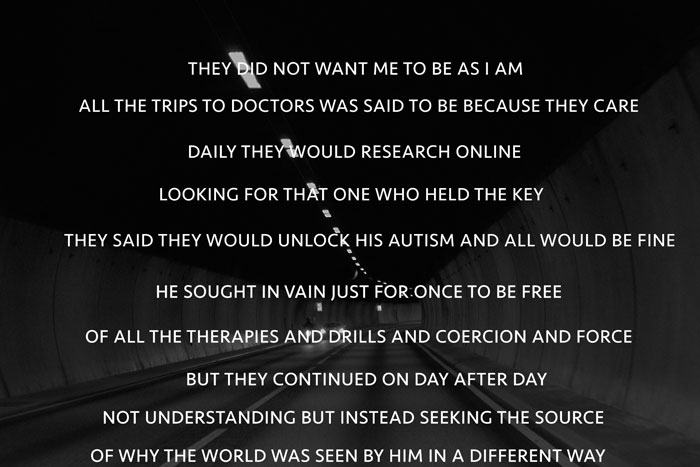
This poem hit me hard. And it made me delve deeper.
Dr Edmunds can voice and share his feelings clearly. Many on the spectrum cannot.
But should we disregard them?
It’s time to give people with autism their due and accept them for who they are.
Your child appears zoned out and does not express his needs, thoughts or feelings. But he absorbs everything.
Imagine how he feels. People talk about his mannerisms and behaviors. His own parents talk about him in his presence, thinking he doesn’t understand. His teachers and caregivers try to make him something that he is not. He always falls short for everyone.
Worse, he feels rejected.
Non acceptance has far reaching consequences like anxiety and depression which don’t show up immediately. They rear their ugly head when the child hits adolescence.
Research shows that anxiety and depression have a high correlation with autism, as high as 90%.
Dealing with mental health issues is often more difficult than dealing with the autism itself.
I’d like to make an important distinction here.
You do not have to accept everything that your child throws out at you. If he screams, hits, displays bad behavior, you must set limits and guide him appropriately.
Teach self help skills, skills of daily living and a way to communicate. These are your parenting responsibilities.
But do not think there is another child behind the ‘autism mask’. Autism defines the way your child thinks.
If you accept that and appreciate his uniqueness, you will help him blossom to his full potential.

Recently, I saw a video of a mother and her teenage son working together. The youngster communicated and shared his deepest thoughts by typing.
He felt the need to stim with his hands and move around every few minutes. Then he would come back and type out his thoughts.
I saw the calmness and serenity the mother displayed. Not once did she force him to stop stimming or to sit down.
She accepted that this was essential to his being. She waited for him to come back by himself and resume typing.
I FELT the trust between the two.
When we accept our children fully, a beautiful relationship of mutual trust builds up.
Acceptance is a dynamic, ongoing quality. It shows in actions rather than words.
Here are a few simple steps that you and I can take today. Yes, me too. This post is as much as a reminder to me as it is to you.
Give Your Undivided Attention
Time with your child will not come back.
When you’re with your child, be fully present. Put that phone away. Whatsapp and Facebook can wait.
Pay attention to your child when he approaches you to show or share something. Imagine how much effort he took to create or share something with you.
If he doesn’t come to you, join him in his world. Look at what he plays with, how he handles his toys.
We operate so much from a place of “I must instruct him”, “he doesn’t understand anything”, or “I must teach him”, that we fail to listen to them and give them our undivided attention.
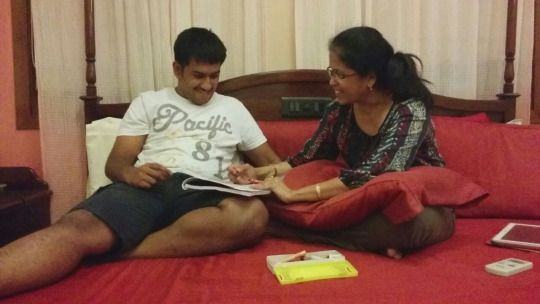
I shudder to think of the times that I absentmindedly listened to or said “yes” to both my kids just to get them off my back.
Be in the moment and let them feel heard.
Your child is not a bunch of excesses and deficits. He is a real person.
Do Things Together
We cannot be together 24/7, but the time spent together should be quality time. Every child craves for time and attention.
Use the 70:30 rule here.
70% of your available time should be spent in doing things with each other. 30% of the time can be spent with the iPad, computer or television.
Involve your kids in your house hold activities. Life is much more than spending time at a table working on flash cards.
Household activities like putting toys away, loading the washing machine, decorating the room together, creating art work are great activities.
Dads, do the sporty things you enjoy – with your kids. It will refresh you and them.
Share Interests and Experiences
If your child has particular interests, let him talk about these interests.
One of my students is an aviation expert. He has a collection of all kinds of airplanes and has extensive knowledge about various aircraft. He shares his knowledge freely with all people willing to lend him their ears!
But most of us categorize it as ‘inappropriate’ and push him as well his airplane knowledge under the blanket.
We have a choice to let him feel heard. What would happen if we listened?
It’s difficult for us to listen to the same story, or the same facts again and again.
But if we don’t listen, who else will? Give your child an outlet.
If your child is non vocal, I know the question hovering in your mind: How will he share his thoughts?
Not being able to speak doesn’t mean he doesn’t comprehend. (Also Read: 9 Points that will Help You Build Communication For a Non-Vocal Child)
Voice your thoughts out aloud instead. I don’t mean a constant barrage. That will drive your child away from you.
But voice your thought process and your decision making.
For example: You’re standing in the kitchen, trying to open a hard to open jar. You could say, “I’m having a tough time. How should I open this?”
Pause.
Your child could be running around, seemingly disinterested.
But here’s the game changer – he’s taking it all in.
Continue sharing your decision making processes.
“Oh I know. I’m going to hold it with a napkin and turn it really hard.” Proceed to open the bottle. Share your experiences, use declarative language.
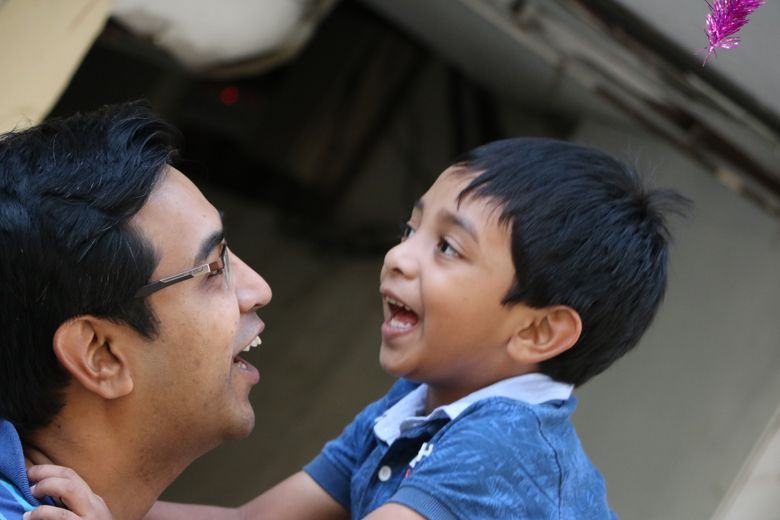
This is the greatest service you could for your non vocal child.
By doing this you presume competence and intelligence.
Stand Up for Him
Your child might have odd mannerisms and behavior issues. He might not be able to talk.
But do you stand up for him or worry about what the world says?
A 25 year old incident comes to mind.
One of my friends was with her son who has autism. Some passerby saw his actions and voiced the much hated word, ‘pagal’!
I asked my friend what she said to the passerby.
“Nothing,” she said.
I was horrified!
Maybe it doesn’t matter to the world, dear friend. But it matters to the young person standing beside you.
Let me repeat this: He may look like he’s unaware. But he’s taking everything in.
If you don’t speak up for him, you’re condoning the fallacy that friends, family and strangers have about Autism.
As Dr. Steve Silberman says, “Let’s move beyond shallow ‘awareness’ of autism, to appreciate autistic people in the fullness and depth of their humanity.”
The ball is in your court. And mine.
I choose to take this challenge by actively accepting my son and my students by following the 4 steps above.
There is an added benefit too.
Once you accept your child, you will be able to see him in all his glory of having a beautiful mind.
People with autism have brilliant minds. They are sought after by many companies in the US.
Change has to start in our minds first- for this to become a reality in India and other parts of the world.
Be present when you’re with your child. Enjoy doing fun activities with him. Share your thoughts and feelings with him and above all, stand up for him.
He may not be the child you envisaged that you would have. But he is beautiful. And your acceptance will help him blossom to reach his full potential. Make this journey beautiful. It need not be burdensome and stressful.
Will you take this challenge with me?