Success stories
3 Steps To Take Before Sending Your Autistic Youngster Away To A Residential Center
-
 |
-
 6 Min read

Share


Scene 1
“I want to live my life. I’m exhausted now.
He’s a good looking 21 year old man who loves to go out and play. My helper takes care of him.”
“He pulled my 15 year old daughter’s hair so badly that some of it came off in clumps. She was traumatized.”
“He also bit my thumb so badly that I had to be rushed to hospital to get sutures.
I used to beat him to discipline him in the past.”
“Now, I’m tired.”
“Please suggest some good residential center for people with autism.”
Scene 2
“We don’t know what to do with him anymore. He constantly asks us to say things in a certain way. He displays ritualistic behavior.
He used to go to school. But there also he got stuck with his behaviors.
The school tried their best to accommodate him. Finally they gave up.
Now we’re sick and tired of his ritualistic behavior.
We have to answer him- otherwise he gets stuck and doesn’t do anything the entire day.”
“Besides, we’re not getting younger. We’re both drained.”
“We are considering some residential facilities.”
Scene 3
“Our neighbours have started complaining. He banged the wall so hard- over a period of weeks, that he made a hole through it. Yes, he injured his hand but wouldn’t stop. He’s fixated with plans. Anything can start an aggressive bout.
I know he’s intelligent but we can’t break through.
Sometimes he throws furniture around. We have to get help to protect ourselves.”
“Let him just live his life and let us live our life.”
“Can you suggest a good residential center?
These are snippets of real conversations I’ve had with families.
A deep pain descends as I write this article.
I understand the parents’ situation.
I know the trauma. I’ve been through the hair pulling.
I’ve had to have stitches and have a crooked forefinger to show for it.
So I’m not judging parental choices here.
All I’m saying is: Before you make a life changing decision like this try to build a relationship with your child.
It’s taken years to build up to such a painful situation, hasn’t it?
Years of effort from you- where things became worse instead of better.
Years of being judged by people about your parenting abilities.
Years of aggression followed by feelings of being drained and traumatized.
You’ve already been through so much.
Can you give yourself one more year?
One year to understand your child and build a relationship with him.
Trust me, it’s not asking for too much.
A year will just fly by.
In this one year you can:
Build a relationship with your child.
All these years, you’ve taught your child skills and language.
That’s not bad at all.
But do you know who he is? Not just the autism or his excesses and deficits. Not just the speech (or lack of it). Not the amount of eye contact he gives you and the skills he has.
But who is he as a person?
I was with a towering 6 footer yesterday. He acted up a little. With his brute strength he could swat me away like a fly.
I looked him straight in the eye and told him I could see through him. He should behave himself, as what he did didn’t bother me.
We spent the next 45 minutes making pasta and listening to his favorite music.
He behaved like a gentle giant. We connected emotionally.
You too can have a meaningful relationship with your child.
You can challenge him. He can grow mentally.
You can cut across the superficiality.
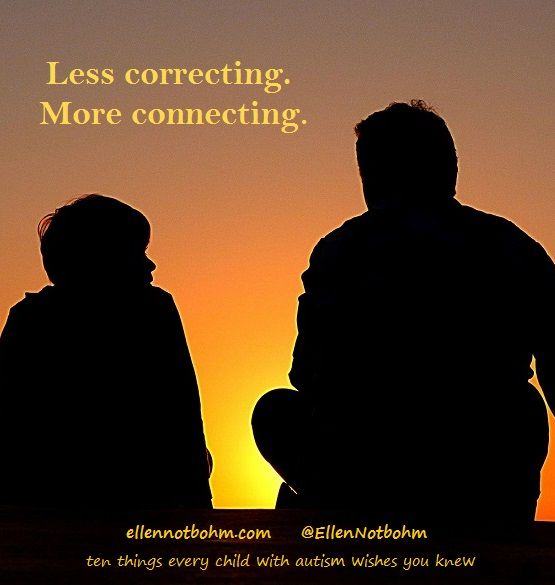
credit: Ellen Notbohm
You can have an emotional relationship with your child.
It need not be based on bribing him, but a deeper reciprocal relationship where you both understand each other.
Empower your child, so that he becomes a thinker and problem solver
Every human being wants to grow and feel challenged.
When you step away from the tumultuous, superficial exterior- you will find a calmness beneath. Then beautiful things will happen in your life.
You can tap this level by challenging your child and teaching him to solve problems and put him on the spot for thinking.
Expect from your child. Believe in him.
Teach him the way he learns.
For this you’ll have to have the courage to let go of ‘conventional teaching,’ because your child learns differently.
By doing this – not only will you empower your child- but you will be empowered too.